
Readiness needs a Series 12. Your recovery score just needs the watch you own.
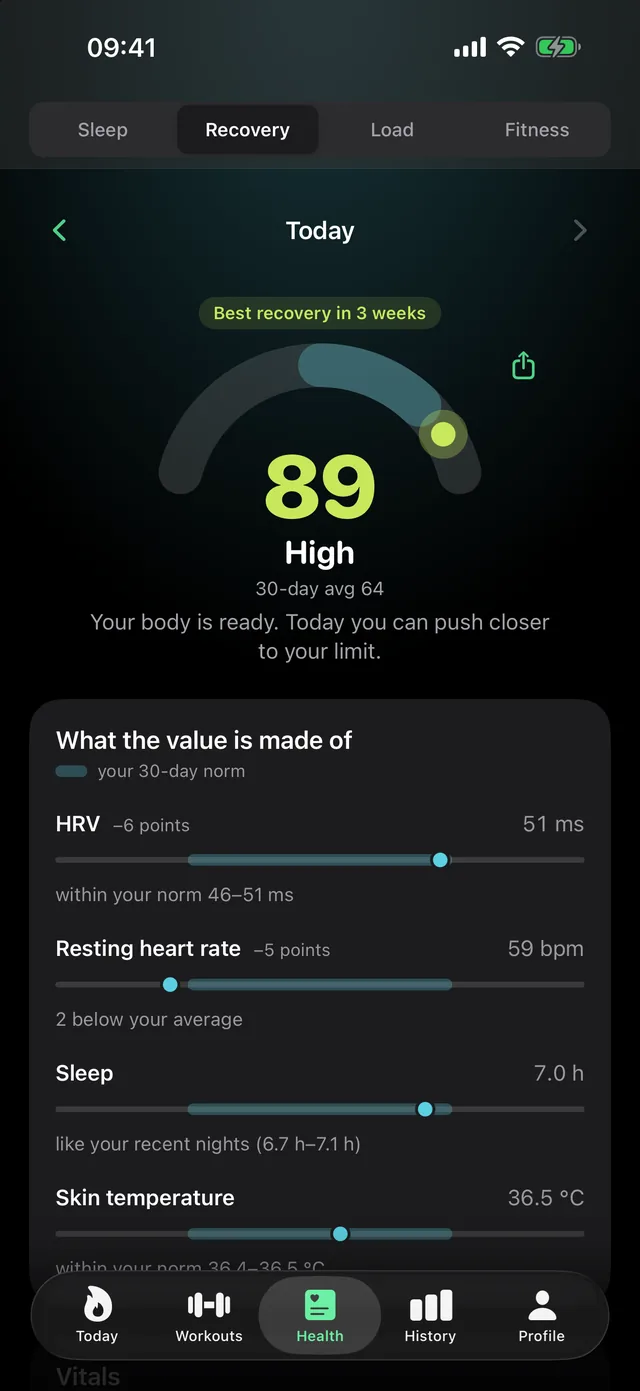
LeibFit reads HRV, resting heart rate and sleep from Apple Health and turns them into a recovery score from 0 to 100 every morning – measured against your own 30-day norm, computed on your iPhone. From Apple Watch Series 4 on. No new watch. And instead of just showing a number, LeibFit turns your readiness straight into today’s strength and cardio training – all in one app.
Free to download. Recovery, sleep and strain stay free for you for good, after the first week too.
- No new watch
- No account
- No cloud
and the original Ultra.
Your watch is enough.
No stranger's reference table.
Your watch is not too old. It is just not the newest.
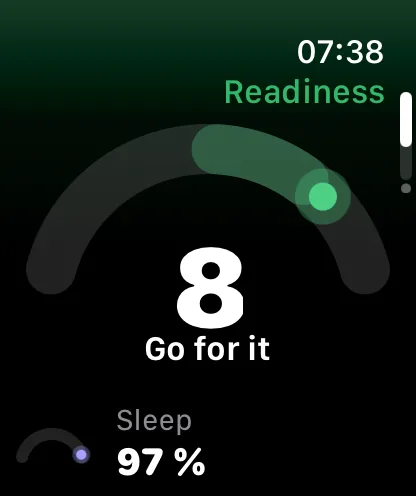
On 9 September 2026 Apple introduced its readiness feature – and tied it to the sensing hardware of the Series 12 and the Ultra 4. Wear a Series 11 and you have the same watchOS on your wrist and still no readiness score.
“I just bought this watch”
An Apple Watch is not a twelve-month purchase. A Series 11 keeps measuring heart rate, HRV and sleep every night – nothing about that changed.
Series 11 · Ultra 3 · Series 10 · Series 9 · Ultra 2“Same system, feature still missing”
This is not an update that arrives later. Apple explains the feature with new sensors and a new chip that can measure more often. Whether older models ever get it, Apple has not said.
Gated by sensors, not by watchOS“A new watch for one number?”
The values a recovery score is built from have been sitting in your Apple Health for ages. What is missing is not hardware, it is an app that puts them in context.
HRV · resting heart rate · sleep, all already therePer Apple’s own material, readiness is a feature of the Series 12 and the Ultra 4: a single score from 0 to 10 with four recommendations, powered by the new Health Sensing System and the S11 chip, which measure heart rate and HRV more often than previous models – HRV as often as every five minutes.
Claims about Apple verified on 5 October 2026; sources: Apple Newsroom (“Introducing Apple Watch Series 12, with the all-new Health Sensing System”, 9 September 2026) and gadgetsandwearables.com. Feature scope and model support can change – please check with Apple directly if in doubt. “Apple”, “Apple Watch”, “Apple Health” and “readiness” are trademarks or designations of Apple Inc., named here descriptively only; there is no affiliation with Apple.
A recovery score that does not depend on the model year
LeibFit is a readiness, recovery and training app for iPhone and Apple Watch – an alternative to Apple's Readiness app for every Apple Watch from Series 4, not just Series 12 and Ultra 4. From HRV, resting heart rate, sleep and strain in Apple Health it calculates your daily readiness every morning and uses it, in the same app, to steer your strength training (weight progression) and your cardio (running and cycling by heart rate zone). It also reads the Amazfit Helio Strap directly over Bluetooth – a Whoop alternative with no extra hardware, no account and no cloud.
Your data stays on the device
No account, no sign-up, no server that receives your numbers, no analytics SDK in the app. The recovery score is computed on your iPhone – not in a cloud you cannot see. There is no copy of your HRV that belongs to us.
Against your norm, not against a table
HRV (weight 0.35), resting heart rate (0.35) and sleep (0.30) are read as a distance from your own rolling 30-day window and mapped to a percentile of your own distribution. Below seven nights of data LeibFit deliberately shows no score, just the baseline building up.
Any Apple Watch from Series 4 on
LeibFit never filters by device, only by data type in Apple Health. LeibFit works with the Apple Watch and with any wearable that writes its numbers to Apple Health; the Amazfit Helio Strap is read directly over Bluetooth, without going through Apple Health. That makes the score depend on a night on your wrist – not on a model year.
And if you have no Apple Watch at all?
Then you do not need one. Since version 1.7 LeibFit reads the Amazfit Helio Strap directly over Bluetooth – without going through Apple Health and without opening the manufacturer’s app. A fitness band costs a fraction of a watch, and recovery, sleep and vitals come out just the same. How the band connection works →
Guidance for your training, not a medical diagnosis. How HRV and the recovery score are actually computed →
From permission to score: one night
No account, no order, no setup that costs you an afternoon.
After seven nights of data the first recovery score appears; until then LeibFit honestly shows the baseline building up instead of a number that does not mean anything yet.
A number that decides the day – not just describes it
A recovery score with no consequence is a thermometer. In LeibFit the training hangs off it.
Hard today or easy today
This morning’s recovery becomes a target corridor for the day’s strain on a 0 to 100 scale. Good recovery puts it high, poor recovery low – and the training adjustment follows the same band, so target and plan can never contradict each other.
Progression that knows your night
Weights climb by double progression – but modulated by the day’s readiness. After a bad night LeibFit does not suggest the same weights as after a good one. You do not avoid overtraining by measuring it, you avoid it by adjusting.
Training plans, the fitness lens, your own baseline and journal correlations are LeibFit Premium: Free to use; training from €44.99/year. Recovery, strain and sleep from the watch you already wear →
Two routes to a morning number
Not a slanging match – the differences that stay, including the one place where Apple’s new watch genuinely measures better.
| Apple readiness | LeibFit recovery score | |
|---|---|---|
| Watches | Series 12, Ultra 4 | any Apple Watch from Series 4 on, plus any wearable that writes to Apple Health |
| Scale | 0–10, four recommendations | 0–100, three bands |
| Reference | recent activity, training load, vitals, sleep score | your own 30-day norm for HRV, resting heart rate and sleep |
| Computed | on watch and iPhone, as a system feature | on the iPhone, with no account and no cloud |
| Steers your training | a recommendation in words | a strain target corridor and weight progression |
| Cost | included with the device | Free to use; training from €44.99/year |
| HRV sampling rate | as often as every five minutes (new sensing hardware) | the samples your watch writes to Apple Health |
Claims about Apple: as of 5 October 2026, source Apple Newsroom. LeibFit values from the app’s own configuration (recovery scale 0–100, bands below 34 / 34–66 / above 66).
Where LeibFit reaches its limits
This page would be dishonest without this paragraph.
The data is thinner than Apple’s new sensing hardware. The Apple Watch files HRV as an SDNN sample in Apple Health, measured opportunistically rather than continuously. That is precisely why resting heart rate carries as much weight as HRV in LeibFit – and precisely why Apple’s more frequent measurement on the Series 12 is a real advantage that LeibFit cannot conjure up on older hardware. What LeibFit puts against it: the comparison with your own history instead of with someone else’s numbers.
No night on the wrist, no score. Take the watch off at night and the basis is gone – then only the training side of LeibFit remains, and that alone is not worth the app. Continuous 24/7 tracking, the way a band you never remove does it, is structurally out of reach.
Not a replacement for Apple’s feature, and not a medical statement. LeibFit does not read Apple’s readiness number and does not reproduce it. And the recovery score is guidance for training – not a finding, not a diagnosis. Also: iPhone only, no Android, no community features.
Questions & answers
Will the Apple Watch Series 11 get the readiness score later?
Apple has left that open. All that is documented is where things stand today: Apple presents readiness in its own material as a feature of the Series 12 and the Ultra 4, and explains it with the new Health Sensing System and S11 chip, which can measure heart rate and HRV considerably more often. Series 11, Ultra 3, Series 10, Series 9 and Ultra 2 run the same watchOS but do not carry the feature. Whether that changes, Apple does not say – LeibFit runs on any Apple Watch from Series 4 on regardless (as of 5 October 2026).
Is the LeibFit recovery score the same thing as Apple readiness?
No, and it does not pretend to be. These are two separate calculations on two separate scales: Apple reports a number from 0 to 10 with four recommendations, LeibFit a value from 0 to 100 with three bands. LeibFit does not reproduce Apple's number, cannot read it, and does not compare itself against it. What both share is the idea: one number in the morning that tells you how much you have in you today.
Which Apple Watch do I need for LeibFit?
Any watch you wear overnight that writes HRV, resting heart rate and sleep to Apple Health – that has been the case since Series 4, SE models included. LeibFit works with the Apple Watch and with any wearable that writes its numbers to Apple Health; the Amazfit Helio Strap is read directly over Bluetooth, without going through Apple Health. So what LeibFit needs is not a particular model, it is a night on your wrist.
How does LeibFit calculate the recovery score?
From three drivers of last night, each as a distance from your own norm of the past 30 days: HRV (weight 0.35), resting heart rate (0.35) and sleep (0.30). That distance is read as a percentile within your own distribution – a day one standard deviation above your mean gives that driver 84 out of 100. If a driver is missing, the remaining weights are renormalised. Below seven nights of data LeibFit deliberately shows no score at all, just the baseline building up. If wrist temperature, respiratory rate or blood oxygen fall more than two standard deviations outside your norm overnight, the score is capped at 50 and flagged as a possible sign of elevated strain.
Why is HRV not the heaviest weight in LeibFit?
Because the data does not support it, and saying so is the more honest route. The Apple Watch files HRV as an SDNN sample in Apple Health – measured opportunistically, not continuously. Resting heart rate, by contrast, arrives already aggregated over the night by Apple itself, as one robust value per day. That is why HRV and resting heart rate carry equal weight in LeibFit; an HRV-dominated weighting on this data would mostly track measurement noise. This is exactly what Apple's new sensing hardware addresses – and that advantage stays with the Series 12 and the Ultra 4.
Does my health data leave the iPhone?
No. LeibFit computes the recovery score on the device. There is no account, no sign-up, no server that receives your numbers, and no analytics SDK in the app. Your HRV, your resting heart rate, your sleep and your workouts stay on the iPhone.
What does LeibFit cost?
Downloading and using it costs nothing. Your three morning numbers (recovery, sleep and strain), the morning journal, the export and the share cards stay free for good, with no subscription and no payment details. You only pay once you want more: starting a workout, the plan builder, the adjustment to your recovery, the fitness lens, your own baseline and the journal correlations are LeibFit Premium at €6.99 per month or €44.99 per year, cancel any time via the App Store. Everything is open for the first week, so you have seen it first.
Is the recovery score a medical statement?
No. It is guidance for your training – not a diagnosis, not an ECG, not a blood pressure analysis and not a substitute for a doctor's assessment. LeibFit tells you that a value sits outside your own norm; it does not interpret it as a finding.
If you want the details
Tomorrow morning your number is there
Your three numbers every morning, free. Training plan and fitness lens when you want more.